Friday, September 23, 2011

Tantalos

Among the memorable characters in Metamorphoses 6 is Niobe, the daughter of Tantalos, the fabled king punished in the Underworld.

Tantalos is remembered in the 1st Olympian Ode of Pindar, which begins,

stands out supreme of all lordly wealth.

Pindar, Olympian 1


If indeed the watchers of Olympus ever honored a mortal man, that man was Tantalus. But he was not able to digest his great prosperity, and for his greed he gained overpowering ruin . . .


Tantalos, Ixion, Sisyphos

. . . he stole from the gods nectar and ambrosia, with which they had made him immortal, and gave them to his drinking companions. If any man expects that what he does escapes the notice of a god, he is wrong.

Wednesday, September 21, 2011

Apropos of Persephone

Persephone Writes a Letter to Her Mother

First—hell is not so far underground—
My hair gets tangled in the roots of trees
& I can just make out the crunch of footsteps,
The pop of acorns falling, or the chime
Of a shovel squaring a fresh grave or turning
Up the tulip bulbs for separation.
Day & night, creatures with no legs
Or too many, journey to hell and back.
Alas, the burrowing animals have dim eyesight.
They are useless for news of the upper world.
They say the light is "loud" (their figures of speech
All come from sound; their hearing is acute).

The dead are just as dull as you would imagine.
They evolve like the burrowing animals—losing their sight.
They may roam abroad sometimes—but just at night—
They can only tell me if there was a moon.
Again and again, moth-like, they are duped
By any beckoning flame—lamps and candles.
They come back startled & singed, sucking their fingers,
Happy the dirt is cool and dense and blind.
They are silly & grateful and don't remember anything.
I have tried to tell them stories, but they cannot attend.
They pester you like children for the wrong details—
How long were his fingernails? Did she wear shoes?
How much did they eat for breakfast? What is snow?
And then they pay no attention to the answers.

My husband, bored with their babbling, neither listens nor speaks.
But here there is no fodder for small talk.
The weather is always the same. Nothing happens.
(Though at times I feel the trees, rocking in place
Like grief, clenching the dirt with tortuous toes.)
There is nothing to eat here but raw beets & turnips.
There is nothing to drink but mud-filtered rain.
Of course, no one goes hungry or toils, however many—
(The dead breed like the bulbs of daffodils—
Without sex or seed—all underground—
Yet no race has such increase. Worse than insects!)

I miss you and think about you often.
Please send flowers. I am forgetting them.
If I yank them down by the roots, they lose their petals
And smell of compost. Though I try to describe
Their color and fragrance, no one here believes me.
They think they are the same thing as mushrooms.
Yet no dog is so loyal as the dead,
Who have no wives or children and no lives,
No motives, secret or bare, to disobey.
Plus, my husband is a kind, kind master;
He asks nothing of us, nothing, nothing at all—
Thus fall changes to winter, winter to fall,
While we learn idleness, a difficult lesson.

He does not understand why I write letters.
He says that you will never get them. True—
Mulched-leaf paper sticks together, then rots;
No ink but blood, and it turns brown like the leaves.
He found my stash of letters, for I had hid it,
Thinking he'd be angry. But he never angers.
He took my hands in his hands, my shredded fingers
Which I have sliced for ink, thin paper cuts.
My effort is futile, he says, and doesn't forbid it.

From Archaic Smile: Poems by A.E. Stallings. Stallings, it was just announced, is a new MacArthur Fellow (Fellow-ess?). She has also translated Lucretius, of whom we were just speaking.

The above text found here.


If not for Poggio...


NPR has two recent, worthwhile stories about the reawakening of the text of Lucretius -- relevant here since Ovid weaves a strain of scientific thinking into his Metamorphoses:

Lucretius, Man of Modern Mystery - NPR's Robert Krulwich talks with Stephen Greenblatt about De Rerum Natura:

As Greenblatt describes it, Lucretius (borrowing from Democritus and others), says the universe is made of an infinite number of atoms ...

... moving randomly through space, like dust motes in a sunbeam, colliding, hooking together, forming complex structures, breaking apart again, in a ceaseless process of creation and destruction. There is no escape from this process. ... There is no master plan, no divine architect, no intelligent design.

and about the Renaissance bookworm who recovered him:

...the unlikely hero of this tale, a young man, who, when he wasn't trying to gouge out the eyes of his fellow secretaries at the Vatican, turned out to be a pretty lucky book hunter. Without Poggio Bracciolini, nobody today would be reading Lucretius.

'The Swerve:' Ideas That Rooted the Renaissance is Stephen Greenblatt's story not just of Lucretius, about whom we know very little, but of his text, of how it almost was lost forever, and of the intellectual bombshells it dropped upon Europe after it was recovered and returned to currency by Poggio..
joy in existence — not suffering, or atoning or endurance — is the point of life. Greenblatt says that some of the world shakers who would be directly influenced by Lucretius' ideas are Galileo, Einstein and our very own American apostle of the "pursuit of happiness," Thomas Jefferson.

Tuesday, September 20, 2011

Medusa, Siracusa, Arethusa

This page about Magna Graecia relates the Sicilian city of Syracuse to the tale of Arethusa, to Corinth, to Medusa, and to the tradition of Greek poetry:

Thucydides [says] Syracuse was founded by colonists from Corinth in ca. 734 BC, led by a man named Archias. After displacing the Sicel inhabitants, the Greek colonists first settled on the island of Ortygia, famous for its fresh water spring, Arethusa.

Syracuse was blessed with the best harbor in Sicily, and grew to become the wealthiest and most powerful Sicilian Greek city. Hieron I, the ruler of Syracuse from ca. 478-467 BC, was host to several famous Greek poets: Aeschylus, Pindar, Simonides, and Bacchylides. The poets Theocritus and Moschus were residents. Archimedes, the most renowned mathematician of antiquity was born in Syracuse. Syracuse's wealth and power attracted the envy of Athens, who attacked the city under the command of Alcibiades in ca. 415 BC. The Athenians, however, were repelled and defeated with the help of the Spartans in ca. 413 BC.


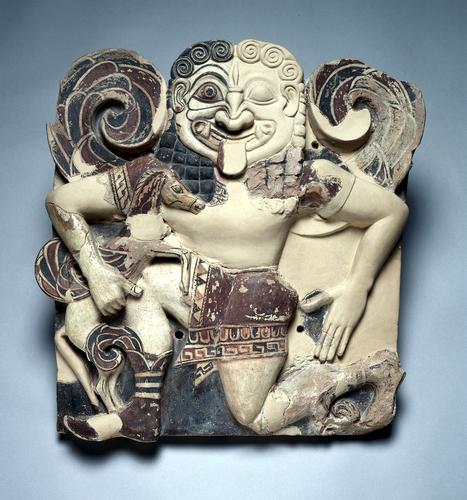
Gorgon Tablet, Syracuse, old temple of Athena, 610-590 BC

This mold-made, painted terracotta tablet is pierced with four holes, suggesting that it was once attached to a large piece of furniture or altar, or served as decoration for a temple. It represents the Gorgon Medusa, in a conventional pose, half-kneeling and half-running, indicating that she is sprinting at great speed. Her wings, curled up over her shoulders, are painted black and purple as is the preserved wing of her right boot. In her right hand she holds her child, the winged horse Pegasus. The figure of her other child Chrysaor was once held under her left arm and shoulder. According to Greek myth, Pegasus and Chysaor were born of her union with the god of the seas, Posidon. In a gory detail not shown by the tablet, these children were born simultaneous with Medusa's decapitation by the hero Perseus. Because the horrifying expression of the Gorgon Medusa was capable of turning men into stone, Perseus accomplished this difficult and dangerous task by viewing her reflected image in a polished shield.

The image of the Medusa with her children was derived from Corinthian antecedents, and became a theme for Sicilian sculptors working in terracotta. This is one of the earliest examples of the theme in Sicily, dated to the end of the seventh, or the beginning of the sixth century BC.
Arethusa's tale connects the Arcadian river Alpheus to the fountain of Ortygia, and introduces the Rape of Persephone:

In Xanadu did Kubla Khan
A stately pleasure-dome decree :
Where Alph, the sacred river, ran
Through caverns measureless to man
Down to a sunless sea.
Kubla Khan

Arethusa (Ἀρέθουσα) means "the waterer". In Greek mythology, she was a nymph and daughter of Nereus (making her a Nereid),[1] and later became a fountain on the island of Ortygia in Syracuse, Sicily.

An engraving by Bernard Picart depicting Alpheus in his attempt to capture Arethusa.

The myth of her transformation begins when she came across a clear stream and began bathing, not knowing it was the river god Alpheus. He fell in love during their encounter, but she fled after discovering his presence and intentions, as she wished to remain a chaste attendant of Artemis. After a long chase, she prayed to her goddess to ask for protection. Artemis hid her in a cloud, but Alpheus was persistent. She began to perspire profusely from fear, and soon transformed into a stream. Artemis then broke the ground allowing Arethusa another attempt to flee.[2] Her stream traveled under the earth to the island of Ortygia, but Alpheus flowed through the sea to reach her and mingle with her waters.[3]

During Demeter's search for her daughter Persephone, Arethusa entreated Demeter to discontinue her punishment of Sicily for her daughter's disappearance. She told the goddess that while traveling in her stream below the earth, she saw her daughter looking sad as the queen of Hades.[4]

Arethusa occasionally appeared on coins as a young girl with a net in her hair and dolphins around her head. These coins were common around Ortygia, the location in which she ends up after fleeing from Alpheus.

The Roman writer Ovid called Arethusa by the name "Alpheias", because her stream was believed to have a subterranean communication with the river Alpheius, in Peloponnesus.[5


Pausanias: RIVER ALPHEIUS

[8.54.1] LIV. The boundary between the territories of Lacedaemon and Tegea is the river Alpheius. Its water begins in Phylace, and not far from its source there flows down into it another water from springs that are not large, but many in number, whence the place has received the name Symbola (Meetings).

[8.54.2] It is known that the Alpheius differs from other rivers in exhibiting this natural peculiarity; it often disappears beneath the earth to reappear again. So flowing on from Phylace and the place called Symbola it sinks into the Tegean plain; rising at Asea, and mingling its stream with the Eurotas, it sinks again into the earth.

[8.54.3] Coming up at the place called by the Arcadians Pegae (Springs), and flowing past the land of Pisa and past Olympia, it falls into the sea above Cyllene, the port of Elis. Not even the Adriatic could check its flowing onwards, but passing through it, so large and stormy a sea, it shows in Ortygia, before Syracuse, that it is the Alpheius, and unites its water with Arethusa.

Alfeios: In the Aeneid, Virgil describes the Alpheus as flowing under the sea to resurface at Ortygia on Sicily, or "so runs the tale".

Stay gentle Swains, for though in this disguise,
I see bright honour sparkle through your eyes,
Of famous Arcady ye are, and sprung
Of that renowned flood, so often sung,
Divine Alpheus, who by secret sluse,
Stole under Seas to meet his Arethuse;
Milton, Arcades

Wednesday, September 14, 2011

A few questions for Calliope

Corinth

The second part of book 5 offers Calliope's tale of the subjection of Typhoeus, the rape of Persephone, the liquification of Cyane, the compromised restoration of Persephone, and the tale of Arethusa.

Even without getting overly involved in the Eleusinian Mysteries, it's clear that with this complex tale from the Muse of epic, Ovid is both composing a work of high art and moving to address the question of art -- what it's for, what it needs in order to flourish, and how it is to be interpreted.

Here are some questions that came to me, I'll be interested in yours:

- In contrast to the magpies, the Muse begins with a paean to Ceres, the goddess normally associated with things more basic than fine art -- the culture of the Earth, planting, harvesting, eating This is the mode of the Georgic (ge + ergon, earth + work, energy):
‘“Ceres first turned the soil with curving plough, first ripened the crops and produce of the earth, first gave us laws: all things are Ceres’s gift. My song is of her. If only I could create a song in any way worthy of the goddess! This goddess is truly a worthy subject for my song.
As we noted last week, this is a remarkable place to begin, and we will need to think about why Ceres (Demeter) is here being linked to the origin of laws.

- The key figures in Calliope's tale are all female (except for Dis) - Cyane tells us she was wedded according to custom; Persephone is seized and is, by the way, the only god in the Greek pantheon to suffer a kind of mortality; Arethusa aims to escape being seized and goes underground, away from Greece, to return to Earth in Sicily. What could be some of the reasons the virgin Muses are so concerned with these virgins, even as they celebrate the great Mother?

- What do we make of the role Sicily plays in Calliope's tale? Is Ovid saying something about the relation of Italian culture to that of the Greeks?

- The wrath of Ceres is a potent element of the story, and its appeasement seems to be essential to the possibility of human life. Why is she so angry? What's at stake for her, and for mankind, in her being reconciled to the new condition of her child?

- What do we make of the minor metamorphoses in the tale - of the loutish boy turned by Ceres into stellio, a starry gecko (Askalabos), and the boy who gave away Persephone's eating the pomegranate seeds, who became a screech owl (Askalaphos)? Why does Ovid seed his tale with these seemingly irrelevant moments? Is it happenstance that the boy figures are so similarly named (we've seen this before) that they appear to have gotten merged in at least one version of their stories?

- In his commentary, Prof. William S. Anderson offers a detailed 14-part outline of the song of Calliope, then adds:
This structural scheme indicates that the Muse does not know how to produce an effective narrative; she cannot refrain from getting herself involved in secondary tales of metamorphosis, which distract us from the supposedly main narrative and present unattractive qualities of both Ceres and Proserpina...
- Anderson, ever the alert reader, is leading to a question we all should be asking ourselves: why does Ovid do what he's doing? Is this song a carmine digna, worthy of Ceres? What does it tell us about his view of the Muse, of poetry, and of his place in the line of poets and their Muses?

Syracuse

- Finally, how does all this relate to Book 5 as a whole, to the story of Perseus and Medusa, and for that matter, to the developing "plot" of the Metamorphoses as a whole, at least so far?


Tuesday, September 13, 2011

Ovid on sources

“The universe is made of stories, not of atoms.” — Muriel Rukeyser

In the Metamorphoses of Ovid, Rukeyser's apothegm is apt -- at least until one remembers that the audience for his stories is often in the position of Athena in Book 5. She has arrived on Helicon to see the marvel of Hippocrene, the spring that upwelled from Pegasus's ungula striking the mountain's rock. Ungula can mean hoof, claw, or talon - a suitably ambiguous term for the extremities of a winged horse.

The Muses welcome Athena and suggest that if she did not have a larger part to play, she'd have been welcome in their "chorus." Art, Ovid is suggesting, is an ally of Wisdom. The Muses then go on to describe their terror at the assault of Pyraneus, followed by Calliope's tale of the goddesses' contest with the Pierides.

Athena here is in the position of hearing, after the fact, a story about a contest of stories (or songs), told by the winners of that contest. And if we think about it, we don't often hear stories told by losers, especially in the case of war. The dead tell few tales.

So just as Perseus gave us his version of how he killed Medusa, or Acoetes his tale of the appearance of Bacchus on his ship, the Muses tell of their victory over the nine daughters of Pierus. Big surprise, the competing story told by the Pierides is an alternate version of theogonic events -- a tale in which Typhoeus, the last monster born of Earth, frightens the Olympians, who rush to Egypt to hide themselves inside goats, rams, crows, cats, cows, ibis and fish. In other words, the Pierides tell a myth of the origin of how certain Olympians became associated in Egypt with certain creatures, but in "explaining" that origin, they are also alleging that the Olympian gods are (1) weaker than Earth-born Typhoeus, (2) scaredy cats, (3) associated with certain natural beings not because those beings manifest something of their nature or power, but because as gods of the sky without real power, they wish to hide from the Earth's hundred-headed giant, and (4), as William S. Anderson notes in his commentary on Ovid's Metamorphoses Books 1-5 (Bks 1-5),
the biased "art" of the Pierid involves slighting the metamorphosis by special verbs and reduction of the gods to epithets. First, then, Apollo is literally inside a raven and Bacchus inside a goat.
This should tell us something about Ovid's view of art and poetry. For him, metamorphosis underlies poetic and artistic creation. The Muses will go on to tell of several metamorphoses, but here their rivals are telling another kind of tale, in which greater force is all that matters, and what fools worship as gods are in fact shameful weaklings hiding inside creatures. This is not poetic -- no transformation is happening, no metaphor, just a deconstruction of cow-eyed Juno into Juno cowering inside a cow. A literal, denotative world devoid of wonder results from a loss, not of gods, but of confidence in the courage and power of gods. Literal language is the language of ninny gods.

The dramatization of the contest of the Muses vs. the Pierides then is Ovid's way of distinguishing false from true art, real inspiration from fake afflatus. This is what it means for art to be linked with Athena. Without her, you get tales told by idiots:

the one who had first declared the contest sang, of the war with the gods, granting false honours to the giants, and diminishing the actions of the mighty deities.

According to his Muses, you must begin with the true source -- it arose from the strike of a winged thing on Helicon, from Pegasus, child of Medusa.


Klimt, Pallas Athena

Saturday, September 10, 2011

Friday, September 9, 2011

JSTOR door is ajar


JSTOR announced it is opening the door to its formerly closed world of academic publications a bit. It has made a substantial collection of academic articles published prior to 1923 available to anyone, free of charge.

To access these early papers, as the video below explains, go to JSTOR's site and click on "Search," then on "advanced search." Then, click on the box next to "Include only content I can access." Type in your search terms and anything that appears can be read online, or downloaded as a pdf. You'll be asked to accept JSTOR's Terms and Conditions.

Thursday, September 8, 2011

D'Epiro, Calvino, Barth, Ovid


Some will recall meeting Peter D'Epiro in July. He emailed these notes re recent postings on this blog. After a few nice words about our efforts, he mentioned two books that might be of interest:

I came across a neat 10-page essay by Calvino in his book Why Read the Classics? It's called "Ovid and Universal Contiguity" and explores some of the reasons the material is grouped the way it is and how he varies the rhythm of his narrative with various patterns and POV devices. It might be worth a look if you can get the book in your libe.
As for the Graiai, Janet and I heard John Barth read at Queens College from his book Chimera when it was published in 1972. He read (brilliantly) from the tale called "Perseid" (a novella)--the scene in which Perseus confronts the sisters and the sleight of hand that takes place with the eye, the tooth, etc. There's also a "Bellerophoniad" in the same book. Might also be worth a look.


Monday, September 5, 2011