Showing posts with label diana. Show all posts

Saturday, May 25, 2013

Hippolytus at the Isthmus


Even then, the horses’ madness would not have exhausted my strength, if a wheel had not broken, and been wrenched off, as the axle hub, round which it revolves, struck a tree. Meta. 15.

The story Hippolytus tells of his own death has to be one of the more semantically charged moments in the Metamorphoses. It would go far beyond the bounds of a blog post to develop a full reading of his character and acts in book 15 and in the poem as a whole. Suffice it to say Hippolytus speaks, as we've noted, without preparation or introduction, and immediately strikes an odd note.

He's not very sympathetic to mourning Egeria, and goes on to recount his chariot crash scene, as if it somehow trumps the nymph's tale of loss. Coming as it does after the long song of Pythagoras, the physicality of the description of his crash, the uncanny appearance of the mountainous wave and the bull, all this narrative energy inserts a strange shock between the reflections and prescriptions of the philosopher and the serene journey of serpentine Aesculapius that follows.

The disfiguring death of Hippolytus is enigmatic at all points: he's one of the greatest horsemen in the world, yet he dies neither in a war nor in an Olympic race, but in an accident involving no other "drivers." He is the son of Theseus, one of the most just, beloved, and balanced heroes of Greece, but he dies cursed by his father for an alleged crime of Venus, though he's a follower of Artemis. He is of the line of Pelops, who was the lover of Poseidon. The god is also his grandfather, yet it's Poseidon's gift that visits Theseus's curse upon Hippolytus.

To unravel this knot, we need to follow threads leading back to violent kings, acts of treachery, and an abandoned princess.

Monday, April 15, 2013

Formless air: Motifs in Metamorphoses 15

When Egeria, consort of Numa Pompilius, disconsolately liquifies at Aricia (Metamorphoses 15:479 ff.), her transformation distinctly echoes the tale of Canens in Book 14, whose lover Picus was lost to her through the wiles of Circe. Canens, the daughter of Janus, evaporates at Rome's river:
The Tiber saw her last, with grief and toil
wearied and lying on his widespread bank.
In tears she poured out words with a faint voice,
lamenting her sad woe, as when the swan
about to die sings a funereal dirge.
Melting with grief at last she pined away;
her flesh, her bones, her marrow liquified
and vanished by degrees as formless air
and yet the story lingers near that place,
fitly named Canens by old-time Camenae!’
The Camenae were nymphs who came to be associated with the Greek Muses. They consisted of Carmenta < carmen (English: "charm") a goddess of childbirth and prophecy, and artificer of the Latin alphabet, her two sisters, Antevorta, goddess of the future, and Postvorta, goddess of the past, and, interestingly, Egeria.

Antevorta, Postvorta, Egeria

Thus the mourning of Canens and Egeria in 14 and 15 are joined not merely in an echoic pathos of vanishing nymphs, but also in linking Canens, lamenting her Picus, and Egeria, mourning Numa, to the fountainheads of Latin and ultimately Greek inspiration. But where the Greek often ends in an Apollonian, visual representation -- recall Circe's statue of Picus at her palace -- these Italic muses dissolve into air, flow, voice.

Thursday, April 11, 2013

After Numa: "The ghastly priest"

Numa's trip to Croton gives us the opportunity to hear Pythagoras's speech. It's one of the longest of the Metamorphoses, comparable to that of Ulysses. (A comparative look at the philosopher from Samos with the hero of Ithaca might prove worthwhile, when time permits.)

More to the point for Metamorphoses 15 is to hear the voice of Pythagoras within the strange narratives that frame it. It's tempting, and far too simplistic, to take the philosopher's speech as in some sense a privileged "reading" of what has come before it. To be sure, Pythagoras does "cover" some of the same ground as books 1-14, with a strong emphasis upon mutability, along with an even stronger ethical argument against the eating of flesh. The Greek contemplative mind is here on display -- far-ranging, vivid, and eloquent. It is accompanied by claims of inspiration from Delphi, elements of prophecy, and extraordinary powers of conception and knowledge.

Yet if Pythagoras wants to have the last word, he certainly doesn't get to have it here. His speech is preceded by the tale of Heracles and Croton. It ends by reiterating the warning against devouring living creatures, beginning with an allusion to the high-flying Phaethon of Book 2 before going on to compare the eating of animals to Thyestean feast, and ending with a warning not to bite off more than we might wish to chew:
Let your mouth be free of their blood, enjoy milder food!
ora cruore vacent alimentaque mitia carpant!
Immediately following this, Numa returns to his people:
he taught the sacred rituals, and educated a savage, warlike, race in the arts of peace 
and dies, in the space of six lines.

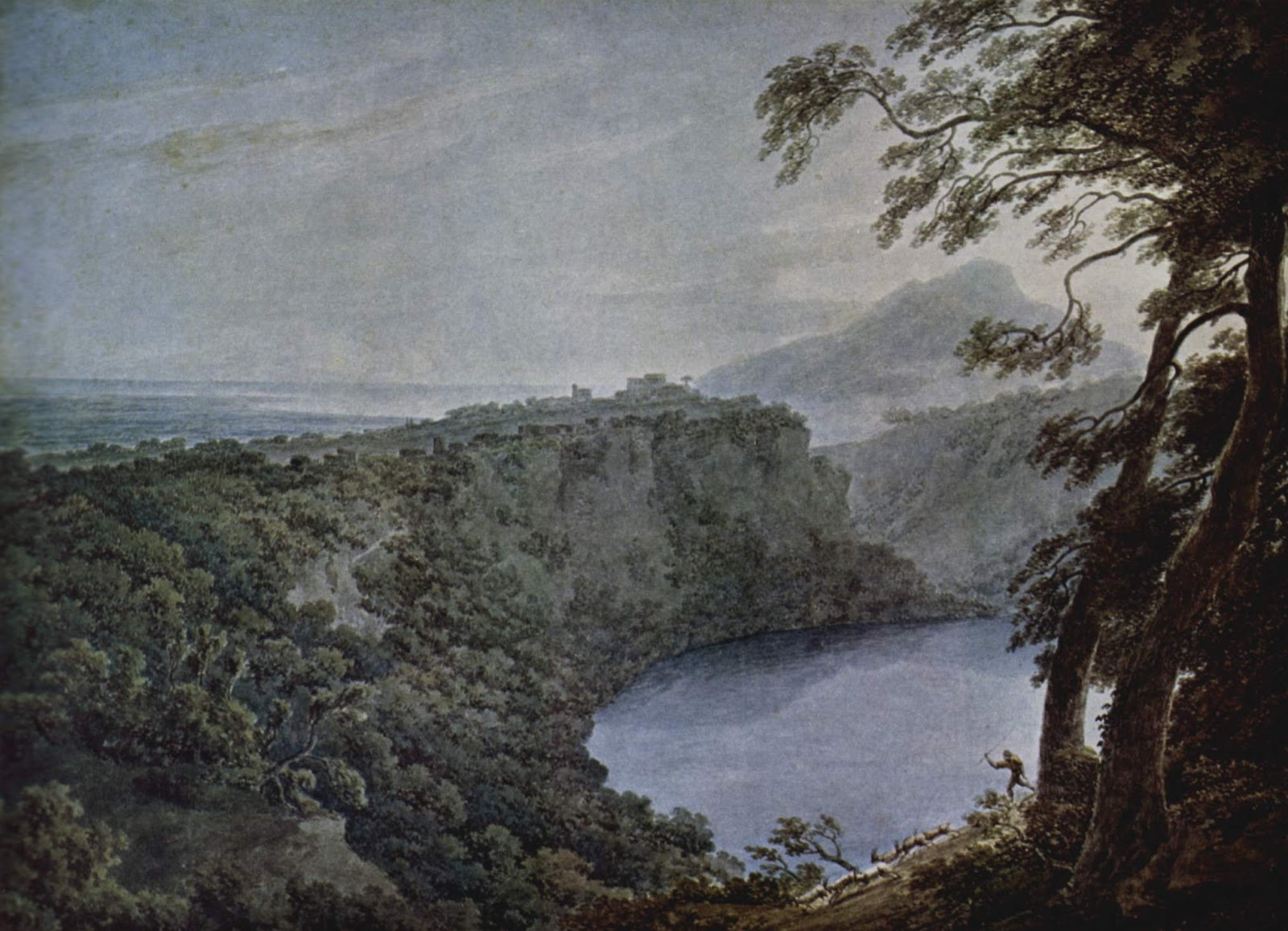
Lake Nemi, John Robert Cozens
The "segue" that follows is complex and unexpected. Egeria, mourning Numa, melts into a spring in "Oresteian Diana's" sacred grove in Aricia, but not before receiving cold comfort from Hippolytus, who will vividly evoke the climax of the Phaedra. With no preparation or foreshadowing, we pass from Numa's "arts of peace" to a sacred place suffused with Greek nightmares about innocent sons of accursed royal houses: Orestes of the House of Atreus and Thyestes, and Theseus' blameless son Hippolytus, destroyed by Phaedra, daughter of Minos and Pasiphaë.

Ovid doesn't drop these references casually. Orestes, the murderer of a murderous mother, and Hippolytus, destroyed by his father's curse at this stepmother's behest, both had come to this Nemorean grove. It was here that Hippolytus instituted the office of Rex Nemorensis, priest of Diana, says Pausanias. The kingship was open to no freemen; only to slaves. To accede to the throne, the escapee had to kill the previous priest, also a former slave, in single combat. The tale attracted the attention of Macaulay:
From the still glassy lake that sleeps
Beneath Aricia's trees--
Those trees in whose dim shadow
The ghastly priest doth reign,
The priest who slew the slayer,
And shall himself be slain 
It inspired Sir James Frazer as well. As Wikipedia notes, the "successful candidate had first to test his mettle by plucking a golden bough from one of the trees in the sacred grove."

As Book 15 moves from Pythagoras to Numa to Hippolytus and eventually Aesculapius, Ovid gives us a good deal to ponder: A peaceable Sabine king dies, his consort hides in triform Diana's grove in Aricia, a place haunted by memories of powerlessness, of refugees from accursed feasts and Cretan labyrinths, the site of a lurid rite of passage and a savage succession of kings.


Friday, March 2, 2012

The house of Achelous


Grottoes were all the rage in 16th Century Italy, and humanists of the time turned to Ovid for the loci classici.

The cave of Achelous in Book 8 is clearly one such scene, where the river god offers Theseus and his companions hospitality:
[Theseus] entered the dark building, made of spongy pumice, and rough tufa. The floor was moist with soft moss, and the ceiling banded with freshwater mussel and oyster shells.
Another is the grotto of Diana in Book III:
There was a valley there called Gargaphie, dense with pine trees and sharp cypresses, sacred to Diana of the high-girded tunic, where, in the depths, there is a wooded cave, not fashioned by art. But ingenious nature had imitated art. She had made a natural arch out of living pumice (pumice vivo) and porous tufa. On the right, a spring of bright clear water murmured into a widening pool, enclosed by grassy banks. Here the woodland goddess, weary from the chase, would bathe her virgin limbs in the crystal liquid. Kline.
Vallis erat piceis et acuta densa cupressu,
nomine Gargaphie, succinctae sacra Dianae.
Cuius in extremo est antrum nemorale recessu,
arte laboratum nulla: simulaverat artemingenio natura suo; nam pumice vivo                          160
et levibus tofis nativum duxerat arcum.
Fons sonat a dextra, tenui perlucidus unda,
margine gramineo patulos succinctus hiatus.
Hic dea silvarum venatu fessa solebatvirgineos artus liquido perfundere rore. III.156 ff
This is the arched grotto and pool where Actaeon met his fate.

A grotto of Diana was included in the gardens of the Villa d'Este in Tivoli:


Villa d'Este pools, fountains gardens

Ovid hints that when one creates a cave of tufa and pumice, one imitates nature imitating art.

Grotte du Grand Roc, Dordogne

Mono Lake, CA


More Italian grottoes:


Grotto of Boboli Gardens, Firenze


Im park der Villa d'Este, Carl Blechen


More images of Italian fountains, some by Bernini, can be found here.

Saturday, February 25, 2012

Questions spurred by a hunt

Some of the questions coming up for me with the story of Meleager, Atalanta, Althea and the Calydonian Boar: What are yours?

1. Prof. William S. Anderson notes that the boar hunting scene is closer to farce than to heroic spectacle, with vignettes of great heroes falling on their faces, scrambling to do pole vaults, and hurling errant projectiles, not without tragic consequences. This might remind us of the bloody massacre at the wedding banquet of Perseus and Andromeda, and goes to the recurrent observation that Ovid seems to tote epic paraphernalia out of the closet only to do strange, poetically subversive things with it. Couple this with the fact that many of the characters whose conflicts and emotions are explored in detail through these tales are women: Arachne, Niobe, Medea, Scylla and Althea, for example. Is Ovid, writing in a cosmopolitan urban setting, consciously broadening the scope of this large-scale poem to attract new segments of readers?

2. Why does Meleager, a young, strong and almost immortal man, choose to invite heroes from all over Greece to participate in the hunt?

Althea with the brand of Meleager
3. Why does the hunting party object to the presence of Atalanta? Why do they object to Meleager's awarding her the spoils of the hunt? Why does he so honor her?

4. Why does Meleager kill both of his mother's brothers? What do they do that provokes his wrath?

5. How is this tale of a powerful, seemingly random natural aggressor wreaking havoc complicated by framing it with the divine elements of the Fates (Parcae), Diana, and the Furies (Poenae), and the fateful acts of his parents, Oeneus and Althea?

6. What to make of the parallel between the "smoldering" feelings Meleager feels for Atalanta and the consuming flames of Althea's act? Why is Althea moved to destroy her son? What is at the core of her almost epic inner conflict?

7. The staging of the hunt, notable for heroes throwing erring projectiles, can certainly remind us of Cephalus and his unerring spear (iaculum). What other relationships might suggest themselves between the tale of Meleager and other preceding tales -- Minos and Daedalus, Minotaur and Pasiphae, Scylla and Nisus?

8. How to take the epic magnitude of the expression of grief that overwhelms Calydon after the death of Meleager and his parents? Especially the sisters:

Not though the god had given me a hundred mouths speaking with tongues, the necessary genius, and all Helicon as my domain, could I describe the sad fate of his poor sisters. 8.533-35

[update] 9. Who is hunting whom?

Thursday, April 14, 2011

Callisto's home


The Callisto story follows that of Phaethon in Metamorphoses 2.

A few language notes: First, the spelling of her name should be Kallisto (Greek for "most beautiful"). See Theoi for more about her - note that among other things, she was the daughter of Lycaon (or Lykaon). We remember him from Book One as the early king of Arcadia who tested the divinity of Zeus by serving him a dismembered child for dinner (in some versions the child is Arcas), and was turned into a wolf for his impiety.

At one point, Ovid refers to Callisto as "Parrhasis" - "one from Parrhasia" - which was a region in southern Arcadia, in the Peloponnese. Only one suggestive detail is associated with Parrhasia: it was said by some to be the place where Rhea, consort of Kronos, bore Zeus. Here's a description from the Greek poet Callimachus:
Callimachus, Hymn 1 to Zeus 10 ff (trans. Mair) (Greek poet C3rd B.C.) :
"In Parrhasia [in Arkadia] it was that Rheia bare thee [Zeus], where was a hill sheltered with thickest brush. Thence is the place holy, and nor fourfooted thing that hath need of Eileithyia nor any woman approacheth thereto, but the Apidanians call it the primeval childbed of Rheia. There when thy mother had laid thee down from her mighty lap, straightway she sought a stream of water, wherewith she might purge her of the soilure of birth and wash thy body therein. But mighty Ladon flowed not yet, nor Erymanthos, clearest of rivers; waterless was all Arkadia . . . And holden in distress the lady Rheia said, `Dear Gaia (Earth), give birth thou also! Thy birthpangs are light.' So spake the goddess, and lifting her great arm she smote the mountain with her staff; and it was greatly rent in twin for her and poured forth a mighty flood. Therein, O Lord, she cleansed thy body."
Another, briefer reference:
"Woodland Parrhasia [in Arkadia], where is still to be found the place untrodden in which primeval goddess Rheia was brought to bed [and gave birth to Zeus]." - Nonnus, Dionysiaca 13.29

Here we might sense a clue as to why Ovid took care to allude to the place name Parrhasia in telling the tale of Callisto: her homeland was sacred to the Great Titan Mother of the Olympians. It was in this rocky, barren place that Rhea, having watched as Kronos devoured all of her other children, chose to bear Zeus. She gave him to nymphs to be raised in secret, handing Kronos the famous swaddled stone to eat instead. Callimachus's description gives us a scene rich in high drama and desperate measures, involving the Titan Goddess's potent maternal instincts.

Parrhasia then is the birthplace of Zeus, and the sacred place where the "father of gods and men" was saved from being devoured by his father. And as we noted, it is associated with Lykaon, who tried to get Zeus to devour a child. This is a doubly sacred place, charged with divine birth, protective maternity, and sacrilegious paternal cannibalism. And, note the absence of water, and how the Goddess solved that problem in order to cleanse baby Zeus.

All of which at least echoes Ovid's tale of Callisto, who is called "Parrhasis" at the very moment Diana suggests they all take a swim:
Ut loca laudavit, summas pede contigit undas:
his quoque laudatis “procul est” ait “arbiter omnis;
nuda superfusis tingamus corpora lymphis.”
460Parrhasis erubuit. Cunctae velamina ponunt:
una moras quaerit. Dubitanti vestis adempta est;
qua posita nudo patuit cum corpore crimen.
Attonitae manibusque uterum celare volenti
“i procul hinc” dixit “nec sacros pollue fontes”
465Cynthia; deque suo iussit secedere coetu.
She loved the place and tested the water with her foot. Pleased with this too she said ‘Any witness is far away, let’s bathe our bodies naked in the flowing water.’ The Arcadian girl blushed: all of them took off their clothes: one of them tried to delay: hesitantly the tunic was removed and there her shame was revealed with her naked body. Terrified she tried to conceal her swollen belly. Diana cried ‘Go, far away from here: do not pollute the sacred fountain!’ and the Moon-goddess commanded her to leave her band of followers. (tr. Kline)
What is Ovid up to? For one thing he's gone from Phaethon's searing story of solar fire to a story of lunar secretiveness, aversion to sexuality and childbirth, and shame. Callisto is severely punished -- first by Diana, who exiles her (in other versions, it's Diana who turns her into a bear), and then by Hera, who is jealous of her bearing a child of Zeus. Both of her secrets are revealed (first, that she's pregnant, then, with whose offspring), and this leads to her being put, strangely, in the position of Rhea in Parrhasia. Callisto can never bathe - either in Diana's hidden pools, or, after her transformation into the Great Bear, in the vast Ocean. She's doubly cursed.

Ovid seems to be playing with the consequences of losing balance, of overshooting one or another temperate zone. This is externalized and literalized in the story of Phaethon. It's internalized and emotionalized in the culmination of Callisto's story -- the hysteria of Hera's lament:
‘You ask me why I, the queen of the gods, have left my home in the heavens to be here? Another has taken my place in the sky! I tell a lie, if you do not see, when night falls and the world darkens, newly exalted stars to wound me, set in the sky, where the remotest and shortest orbit circles the uttermost pole. Why should anyone wish to avoid wounding Juno or dread my enmity if I only benefit those I harm? Oh what a great achievement! Oh what marvellous powers I have! I stopped her being human and she becomes a goddess! This is the punishment I inflict on the guilty! This is my wonderful sovereignty! (tr. Kline)
From the paternal, solar myth in which Helios mourns the failure of his overly daring son to succeed him, Ovid's narrative has swung to the plight of a woman suffering the wrath of two goddesses: Diana, the lunar goddess of virginity and the hunt, and Hera, goddess of childbirth, who fears her own usurpation.

It little matters that Callisto neither meant to be pregnant nor to have her impregnator be Zeus. Her exile into the polar sky leaves her, like Io, seduced, transformed, and hounded by Diana and Hera into the restless night.


Tuesday, February 22, 2011

Ovid by Titian for the King of Spain, in Scotland

I remember being surprised and delighted to find some Titians in Edinburgh a few years ago, and there's a story worthy of Ovid behind why they're there. But first, Ovid himself:

According to Meta. 2.401ff, it was Jupiter (the Roman Zeus) who took the form of Artemis/Diana so that he might evade his wife Juno’s detection, forcing himself upon Callisto while she was separated from Diana and the other nymphs. Her pregnant condition was discovered some months later while bathing with Diana and her fellow nymphs.

Upon this, Diana was enraged and expelled Callisto from the group, and subsequently she gave birth to Arcas. Juno then took the opportunity to avenge her wounded pride and transformed the nymph into a bear.

Sixteen years later Callisto, still a bear, encountered her son Arcas hunting in the forest. Just as Arcas was about to kill his own mother with his javelin, Jupiter averted the tragedy by placing mother and son amongst the stars as Ursa Major and Minor, respectively.

Juno, enraged that her attempt at revenge had been frustrated, appealed to Oceanus that the two might never meet his waters, thus providing a poetic explanation for their circumpolar positions. Wikipedia
Commissioned by Philip II of Spain, Titian's painting of this story from Ovid, and another of Diana and Actaeon, are now for sale in Scotland. NPR has the story here. Ovid is everywhere.