Showing posts with label Arachne. Show all posts

Monday, April 16, 2012

Ovid's shifting texture

Ovid's grouping of tales is enormously suggestive, and infinitely elusive. One sees patterns everywhere, but when one tries to tie them up into neat thematic or formal packages, the actual linkages and segues from one tale or set of tales to the next seem designed to defeat any basic order that might fit neatly into a PowerPoint demonstration.

We can say that books 1-5 appear to form a unit, and again, books 6-10 seem a middle group. And taking just the books we've read so far within the latter group, one can see certain thematic concerns:

Niobe
Book 6 - Matters of Art, mimesis, hubris, human making vs. divine creation. (Arachne, Niobe, Marsyas).
            - Human rape and privation of speech (Tereus, Procne, Philomela); divine rape (Boreas and Orithyia).
Book 7 - Foedera - Bonds of trust and mistrust - how well can one know the other? Bond between men, cities, men and gods, men and women. Tales of rejuvenation. (Medea and Jason, Plague of Aegina, Aeacus and Minos, Cephalus and Procris). 
Book 8 - Love, Defenses and Vulnerability, Randomness vs. Necessity. (Scylla and Nisus, Minos and Daedalus, Daedalus and Icarus, Diana and Oineus, the Boar, Meleager, Atalanta, Althea).
            - Hospitality, Desire, Economics: (Achelous, Philemon and Baucis, Erysichthon and Mestra).

One "pattern" that emerges is that in each of these books, the major narrative thrust seems to break, or shift gears, near the middle. For example, the tales of human artists and the gods they anger in the first half of book 6 give way to the long, bloody account of Tereus and the violent "art" of Philomela and Procne.

In 7, the very long narrative of Medea ends abruptly with the advent of Theseus, and the second half of the book relates to humans grappling with divine gifts.

In book 8, a series of tales involving love and or vengeance penetrating and destroying fortified places is followed by stories of hospitality and its absence.

It would seem that Ovid is going out of his way to disrupt some easy order of coherent narrative units that would coincide with the beginnings and endings of his poem's books. He would much rather introduce new matter in the middle of a book and have it wash over into the beginning of the next, as he does with the figure of the river god Achelous in book 8. The god appears in the middle to divert Theseus from attempting to cross him, and the ensuing symposium lasts until well into book 9, ending with the defeat of Achelous at the hands of Heracles.

Hercules vs. Achelous as bull

In another post I'll examine some of the patterns within a single book that might be worth considering.


Thursday, February 16, 2012

The daedal fates of Icarus

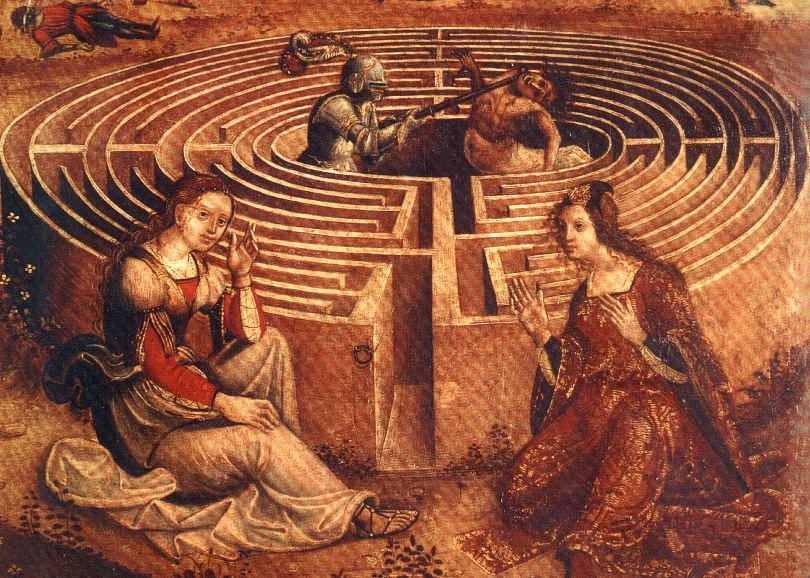
As noted the other day, Ovid's Daedalus has much in common with his Arachne. Both are painstaking artificers who seek to go beyond merely imitating nature. Daedalus' design for the labyrinth of Crete was, Ovid notes, inspired by the Maeander River, near Miletus in ancient Caria:
No differently from the way in which the watery Maeander deludes the sight, flowing backwards and forwards in its changeable course, through the meadows of Phrygia, facing the running waves advancing to meet it, now directing its uncertain waters towards its source, now towards the open sea:
His design for his escape from Crete was based upon nature's model as well:
he applied his thought to new invention and altered the natural order of things. He laid down lines of feathers, beginning with the smallest, following the shorter with longer ones, so that you might think they had grown like that, on a slant. In that way, long ago, the rustic pan-pipes were graduated, with lengthening reeds. Then he fastened them together with thread at the middle, and bees’-wax at the base, and, when he had arranged them, he flexed each one into a gentle curve, so that they imitated real bird’s wings. (Kline)
Like Arachne, Daedalus is entirely absorbed by his art, his techne. He is a problem solver. He solves Pasiphae's problem, then has to contain the problematic issue of that "solution" for Minos:


Friday, November 4, 2011

Ovid and Reversibility

One thing we learn from Ovid is that something that seemed immovable, assured, irreversible, can rather suddenly be turned upside down. We noted the other day the swiftness with which the gods act: before Arachne can finish challenging Athena to come and compete in a contest, "venit," says the crone, and the goddess is before her.

The gods waste no time. Apollo, in responding to Leto's plea to chasten, teach, or destroy Niobe, cuts his mother short. Desine, he says - "leave off talking" - and the arrows begin to fly.

Similarly with Breughel's rendering of the boorish Lycian peasants who deny a goddess water -- which, as she notes, is a public resource. Before our gaze can take in Breughel's scene, one of the peasants has already turned into a frog. Sudden, strange metamorphoses veer from the orderly, normative world of realism toward Breughel, Bosch, and Kafka.

Every time in Metamorphoses 6 that a mortal oversteps some boundary, however you wish to characterize it -- human/divine, mortal/immortal, imagination/reality, public/private, copy/original, one/all, student/teacher -- there is a sudden comeuppance, a kind of electric contraction, or syncope; what results is an enigmatic determination of the overreaching character.

The case of Marsyas is a little different -- there was an agreement that either Apollo or the satyr would submit totally to the will of the other. Yet the suddenness with which Ovid tells the story -- moving right to the "innards," as it were, is at one with the speed of the other actions.

What each of these four metamorphoses shares with the others is both this sense of instantaneous finality, and also a clear reversal of the fortune and place of the character undergoing the transformation. Marysas, for example, is literally turned upside-down, the very thing he was unable to do with his tibia in response to Apollo's reversed cithara.

To each of these characters it's revealed that things are, in reality, quite the opposite of how they imagined them to be -- but this discernment (certamen, as we have seen) is not something necessarily conveyed by words, discursively, to the character's understanding. Rather, it's what is experienced and made palpable in the flash of metamorphosis. Arachne, for example, experiences the violence of being pounded with the shuttle, rather than triumphing in her claim of being the more potent spinner. She ends without hands -- a small, nearly sense-less belly that nonetheless makes webs. For Ovid's reader, she becomes a fixed talisman, a legible reminder of her singular truth. Poetic justice.

This quality of the world -- for something, or someone, to suddenly become other to themselves, and to have their entire sense of things reversed -- is germane to what Ovid is telling us in the Metamorphoses. It requires us to entertain the possibility that nothing is fixed, nothing is certain, nothing is what it seems. This is not the same as saying all is random, accident, chaos. There's an order in this world, but it's an order in which error is the comfortable, everyday norm -- to err is human -- while the undoing of error, instead of restoring the errant one to some healing condition of insight, is often worse than error. You might happily live in Lycia, the land of the Chimaera, thinking you're the greatest spinner who ever was. Unless the web you're spinning is a noose, and, like the open door that Kafka's seeker can never enter, it's just for you.

For Ovid, art involves imagination, which morphs into illusion and error; to be disabused of that error by Athena is not necessarily redemptive, though it can leave a painful admonishing residue for others to sift through.

Ovid's direct style strikes us as oddly modern, even contemporary, but so does his world. His 21st century readers live in a moment in which basic certitudes are dissolving before their eyes. Recent reversals in science challenge some of our most cherished truths. We have all heard about the ghostly neutrinos that appear to be moving faster than the formerly fastest thing, light.

But there are other earth-shakers. Here, for example, is the physicist Brian Greene, talking about how the notion of the Multiverse is transforming basic assumptions:

We're all used to that gravity is attractive: You let go of something, it falls to the Earth. Earth pulls things toward it. But there's a kind of gravity that does the reverse. Repulsive gravity pushes outwards. And we believe that in the early, early universe, repulsive gravity was in operation, and that repulsive push is what drove everything apart.
Another physicist, Michael Murphy, relates disturbing findings that constants of nature are turning out to be not quite constant (podcast here). Then there's quantum entanglement.

It seems we no longer live in Newton's, or Einstein's, predictable nature grounded in immovable laws and certitudes. Those thinkers were more like Virgil, who dared to posit a universal plan, and to tell us what it was.

The recent spate of usurpatory thinking is very different from Newtonian physics and Virgil. The inconstant speedy multiverses of today's science might feel more at home in the syncopated world of Ovid's Metamorphoses.

Friday, October 28, 2011

Variations upon Fate in Book 6

In Book 6, Ovid takes up not simply art per se, but art in relation to wisdom -- as we have seen in the tale of Arachne and Athena. And while the enigmatic end of that tale is still being mulled, we should note that Ovid now seems to break with the theme of "art" in the narrow sense, as he turns to Niobe.

After reading that tale, we might be in a better position to say whether Ovid has dropped his exploration of art and wisdom, or has in fact broadened it. The vast system of Greek myth gave Ovid great latitude -- by moving from the poor country girl (who could equal Athena in spinning) to the daughter of Tantalos, the most powerful queen of her day and sister of Pelops, Ovid seems to be asking us to expand our sense of what the theme, the substance of Book 6, really is.

We move, on one level, from a humble artificer to a noblewoman at the peak of her fortune, from the girl who, like a human parody of Clotho, spun her own fate, to the queen who, presuming to be absolutely in possession of her great good fortune, lived to watch the sudden severance of those lives she thought she had the measure of -- clipped by the shears of Atropos.

Tantalos, Niobe's progenitor, foreshadows her tragic end: As his daughter, she's heir to the strange fortune of her father, who was the most favored of mortals before becoming the most accursed of them.

It would take us farther afield than is reasonable, but the grouping of Tantalos, Sisyphus, Ixion and Tityos is worth exploring when we can, and not only because of their egregious eternal punishments. Tantalos, Sisyphus and Ixion were all unusually favored and gifted. They just went too far (not unlike Prometheus) -- Sisyphus got the better of Hades, Ixion tried to outwit Zeus, and Tantalos has a most peculiar story vis a vis the entire dynasty of the Olympians.

As Pindar says:

If indeed the watchers of Olympus ever honored a mortal man,
that man was Tantalus.

I hope to explore some of the features of the Tantalos figure in another post (I'll link to it here when it's up). It's enough now to note that Ovid, in moving from Arachne to Niobe to Marsyas, is touching on the making of images, of self image, and of voiced music -- before he turns to the tale of Procne and Philomela. The first three tales concern mortals vying with immortals -- as Tantalos and Co. had done. The next tale -- that of Tereus, Procne and Philomela -- concerns mortals alone. Yet as we'll see, the making of image, of self-image, and of voice return in that tale, horrifically.

My point is simply to remember that the tales of Book 6, mostly set in Asia Minor, take place in the land of one of the most enigmatic ancient characters, the son of Zeus and Pluto. Pindar's 1st Olympian continues:

If indeed the watchers of Olympus ever honored a mortal man,
that man was Tantalus.
But he was not able to digest his bliss,
and for his greed he gained overpowering ruin,
which the Father hung over him: a mighty stone.
Always longing to cast it away from his head,
he wanders far from the joy of festivity.
He has this helpless life of never-ending labor,
a fourth toil after three others,
because he stole from the gods nectar and ambrosia,
with which they had made him immortal,
and gave them to his drinking companions.
If any man expects that what he does escapes the notice of a god,
he is wrong.


Tuesday, October 18, 2011

Verisimilitude and Origination in Metamorphoses VI

One theory of art that Ovid would certainly have known is found in Aristotle's view of art as mimesis, or imitation. In relation to the competition of Athena and Arachne, it seems necessary to distinguish between art as imitation and another kind of art.

The first kind -- Arachne's -- offers us imitation as fidelity to appearance -- making a careful copy of something. If you are a very good imitator, your copy can be said to rival Nature. Trompe l'oeil art is, in a sense, the ultimate in imitative success, since it actually fools us into thinking something is real, when it's an artistic illusion. Arachne's art is of this kind -- not only do her images rival those of nature, but there is a double rivalry, because what she's imitating is the power of the gods to imitate natural things - bulls, golden showers, horses, etc. Just as Zeus successfully impersonated a bull and seduced Europa, so Arachne's tapestry seduces the viewer into believing one is actually seeing Zeus as bull seducing Europa.

Of course this imitation of divine imitation is also a distinct echo of Ovid's tale of Zeus and Europa which ended Book 2 of the Metamorphoses, so there is a mirroring of imitative reflection that verges on a mise en abyme. The endless mirroring suspends the viewer in an undecidable predicament, which nonetheless requires a decision. Think of the final scene of Orson Welle's The Lady from Shanghai, where the characters shooting the guns have to tell, but can't tell, if they're aiming at the actual person, or at a reflection:


The labyrinth of Arachne's tapestry leads one into a world where all is imitation, cheat, illusion, and virgins are forever being seduced by clever divine rapists.

Despite the undeniable similarity of Arachne's subject matter to that of the very book in which she appears, we should at least look at Athena's image before deciding that the theory of art as mimesis in Arachne's sense of it is Ovid's own.

Clearly Ovid is setting up an opposition between Athena and Arachne to at least offer an alternative theory of art; so what can Athena's tapestry tell us?

At first glance, her image seems very much in the same vein of imitation. Athena has presented the story of how she won a contest with Poseidon at Athens. We see Poseidon striking water from the Acropolis, and then Athena striking the rock and giving the Athenians the precious olive tree, a living source of health and wealth, of culture and strength.

One thing about the goddess's image should be clear: the excellence of the work does not lie solely in its verisimilitude. Doubtless the Athena in the tapestry resembled the goddess who wove her, but that's not what really matters here. What matters is the act that that this is an image of -- the act of making, creation, poesis. Athena didn't merely put a copy of an olive tree in Athens, as if the city could have found another one elsewhere. She is putting something brand new into the world. The gift of the goddess is not something anyone else could have given the city, it is a novum, a thing so extraordinary that even the gods marvel at it.

The story Athena tells in her tapestry culminates in the people choosing her as their patron, an act that is marked by naming the city, and themselves, after Athena. Not only is there a new kind of tree, but a new word. Athena's image is about this non-mimetic creative power, the poetic power of naming.

There's another difference between Arachne's mode of art and that of Athena, and it has to do with how, or to what, each directs our attention. Arachne's art is essentially about itself. It says, "look at how well I have feigned this story of a god feigning to be a bull." Athena's image is not very interested in making a faithful copy of something, because it's concerned with something that is fundamentally other than copying. It's interested in the powers of imagination. As an image, it points beyond itself, it tells us not to look at how well it's copied some event, but instead to think about an act of origination, the origin of "Athens."

How are we to understand what Ovid is telling us about art? It seems that there are certainly two kinds, or theories, of what art can be, but which is to be preferred? Would it not seem that the similarity of Arachne's images to events described in his poem would tilt the balance toward the imitative art of the girl? Or is this yet another twist of Ovidian irony, in which he's suggesting that if we read his poem as an imitative work of fancy, we are getting it all wrong? Is Ovid perhaps giving us a hint about how his poem is to be read? Or is he just offering a kind of sampler of aesthetics, saying, "here are two kinds of art"?

Given that these two modes of art seem in some sense to be opposed -- in one, the image is about its own intrinsic "imageness," in the other the image points to something beyond mere imitation -- perhaps a decision is important, and not simply for aesthetic reasons. Note the relation of each artist here to the theological, for example. And then there's the relation of all of this to hubris.

The violent climax of Ovid's story might make us suspect that the two modes of "art" -- in the larger sense to which we have been led -- are not simply opposite, but fundamentally incompatible. At this point we have to ask whether the brutal conclusion to the contest resolves the enigma posed by the conflicting webs of Athena and Arachne, or destroys any hope of doing so.

Wednesday, October 5, 2011

Harrowing ambiguities


Imitation, or mimesis, is inherently ambiguous -- if not, it wouldn't be imitation. But the relation of copy to original can be difficult to decide, and the legendary tales of trompe l'oeil works of the Greek painters dramatize the element of cheat, of trickery:
Zeuxis and his contemporary Parrhasius (of Ephesus and later Athens) are reported in the Naturalis Historia of Pliny the Elder to have staged a contest to determine which of the two was the greater artist. When Zeuxis unveiled his painting of grapes, they appeared so luscious and inviting that birds flew down from the sky to peck at them. Zeuxis then asked Parrhasius to pull aside the curtain from his painting, only for Parrhasius to reveal the curtain itself was a painting, and Zeuxis was forced to concede defeat. Zeuxis is rumoured to have said: 'I have deceived the birds, but Parrhasius has deceived Zeuxis.'
Interesting that much of Zeuxis' work ended up in Rome, where Ovid certainly would have seen it - and also noteworthy that one famous subject of the artist was Marsyas.

Our lively discussion of Athena vs. Arachne today was, in a very real sense, provoked by the way Ovid designs his tale, his argumentum. Ovid calls the stories depicted in the webs of his contestants the vetus argumentum for a reason -- not only will they be submitted to be judged in the contest (certamen <- cerno), they are also arguments about the nature of art and its relation to nature, to inspiration, and to the divine.

To judge an argument critically, it must be sifted, discerned, tested. The root of argument is arguo, which means prove, or assert, but that sense quickly slides into "reprove, accuse, blame, censure, denounce." The root rests uneasily on the creaky fence that divides the certitude of rational and evidentiary processes such as science and logic on the one hand from the vitriol-charged rhetoric of prosecutorial denunciation on the other.

The discussion surrounding Athena and Arachne has many elements, ambiguities, and angles, because Ovid refuses to let the contest remain simply within what we normally think of as "aesthetics" -- i.e., whether something is beautiful, and if we compare two works, which is moreso. The contest here is between Wisdom's ars and that of a mortal girl. The harrowing ambiguities in the way it plays out -- the ire of Athena and disfiguration of Arachne -- are not easily "settled" by some neat allocation of good vs. evil.

What is clear from the tale, as well as others in Book 6, is that ambiguities can be harrowing, and Wisdom is not always tolerant. The book begins with Athena being reminded by the tale of the Muses in Book 5 of iustam iram - "rightful wrath" (Golding's translation). We certainly witness her iram towards Arachne. The question that the violence in the tale compels us to decide is whether we are dealing with a wise intolerance, or a most intolerant Wisdom.


Sunday, October 2, 2011

Art, violence, hubris


A few questions implicit in Book 6 (Standard disclaimer: I don't know the answers, though I have some suspicions).

- What is Arachne's main offense - her art, or her attitude toward Athena?
- Does Arachne's image somehow reflect her attitude?

Perhaps a better question:
- When we compare the images woven by Athena and Arachne, how do they differ? Are we able to see different models of art?

Three kinds of certamen (that is, contest - from cerno, to separate, discern) make up the early stories of Book 6: "Athena vs. Arachne;" "Leto, Apollo, Diana vs. Niobe," and "Apollo vs. Marsyas."
- Does the story of Tantalos, king of Lydia, and Pelops, his son, relate to these tales? (Tantalos is the father of Niobe, and Pelops mourns her).

With respect to Phrygia:
The earliest traditions of Greek music derived from Phrygia, transmitted through the Greek colonies in Anatolia, and included the Phrygian mode, which was considered to be the warlike mode in ancient Greek music. Phrygian Midas, the king of the "golden touch", was tutored in music by Orpheus himself, according to the myth. Another musical invention that came from Phrygia was the aulos, a reed instrument with two pipes. Marsyas, the satyr who first formed the instrument using the hollowed antler of a stag, was a Phrygian follower of Cybele. He unwisely competed in music with the Olympian Apollo and inevitably lost, whereupon Apollo flayed Marsyas alive and provocatively hung his skin on Cybele's own sacred tree, a pine.
Marsyas, Amphion (husband of Niobe), Orpheus and Midas are all associated with Phrygia, and are linked via the power of music.
- What do we make of the brutal fate of Marsyas? And his metamorphosis - with the tears of his mourners - into a river?
- Do the differences between cithara and flute say something about what's at issue between Apollo and Marsyas?

- How does the story of Tereus, Procne and Philomela fit into the theme of art as established and anticipated in Book 5 with the story of Athena, Medusa, Pegasus and the Muses?

- What is Ovid saying in this book about the nature of art, of "creation and imitation, god and man, master and pupil," and the powers of image and of music?

Thursday, September 29, 2011

Velazquez's Image of Arachne's Image

Velazquez, Las Hilanderas

I wonder if anyone ever knew more about mirrors than Diego Velazquez.

A more precise title for this blog post would be: "Velazquez's image of Ovid's image of Arachne, and Arachne's image of Europa as seen via Velazquez's image of Rubens' image of Titian's image."

I'd never seen or heard of this painting of his before -- it's called The Spinners. Click to make it larger -- it's quite something. Apparently it interweaves two moments of the Arachne story, and for good measure, throws in a tapestry image of the rape of Europa.

The tale of Arachne inspired one of Velázquez' most interesting paintings: Las Hilanderas ("The Spinners, or The fable of Arachne", in the Prado), in which the painter represents the two important moments of the myth. In the front, the contest of Arachne and the goddess (the young and the old weaver), in the back, an Abduction of Europa that is a copy of Titian's version (or maybe of Rubens' copy of Titian). In front of it appears Minerva in the moment she is punishing Arachne. It transforms the myth into a reflection about creation and imitation, god and man, master and pupil (and therefore about the nature of art).
Let's bear in mind this "reflection" of Ovid as we read the poet's own version. Clearly Book 6 is grappling with "creation and imitation, god and man, master and pupil," and therefore is very much about the nature of art.


Titian, Rape of Europa