Showing posts with label dante. Show all posts

Saturday, December 24, 2016

Coally prattling birds

The appearance of the gaggle of pole -- jackdaws, or grey crows (cornacchie grige) - in Paradiso 21 is a strangely unsolemn moment in an otherwise almost forbiddingly sober canto. Jackaws are usually not associated with contemplation - and the variously active groups of birds described in the simile seem busy, but not intent upon higher things:
And as accordant with their natural custom
  The rooks together at the break of day
  Bestir themselves to warm their feathers cold;

Then some of them fly off without return,
  Others come back to where they started from,
  And others, wheeling round, still keep at home; 
Such fashion it appeared to me was there
  Within the sparkling that together came,  (21:34-41)
Robert Hollander notes that these birds have "black wings, silver eyes, and large red beaks encircled by yellow," and adds that according to Benvenuto, they love solitude and choose the desert for their habitation.

Thanks to Dren, we now know our black birds have a holiday tie-in, via Ovid, no less. He shared this piece from the Washington Post that offers a bit of philological archaeology. It turns out that while we all sing "four calling birds," during the Twelve Days of Christmas, the original line involved "coally birds," an adjective derived from, and sounding like, "coal."

The OED finds the word in Golding's translation of Ovid's Metamorphoses - the tale of Coronis and the raven who told Apollo of her infidelity.
As thou thou prating Raven white by nature being bred,
Hadst on thy fethers justly late a coly colour spred.
Indeed, we might have Ovid to thank for Golding's bringing the word into print, and giving it the opportunity to be mistaken for "calling birds," thus helping perpetuate the derangement of language which happens to be a prominent theme in the second book of the Metamorphoses. (See, for example, here.)

Thursday, May 23, 2013

A Dantean moment

There might be no more "Dantean" moment in the Metamorphoses than the sudden sound of Hippolytus's voice in book 15. For a comparison, consider the scene in Inferno 10 when, as Dante and Virgil are walking amid the open tombs in the City of Dis, they're suddenly interrupted by a deep voice from within a tomb:

O Tosco che per la città del foco
vivo ten vai cosù parlando onesto,
piacciati di restare in questo loco.

O Tuscan, thou who through the city of fire
Goest alive, thus speaking modestly,
Be pleased to stay thy footsteps in this place.


Farinata rises from his burning grave because he hears his native Florentine speech, and seizes the opportunity to hear of the living world. 

Ovid's Egeria is disconsolate at the death of her consort, Numa, when she is suddenly interrupted:
How often Hippolytus, Theseus’s heroic son, said, to the weeping nymph: ‘Make an end to this, since yours is not the only fate to be lamented: think of others’ like misfortunes: you will endure your own more calmly.'
The appearance of Hippolytus is doubly unexpected -- nothing prepares us for the fact that he did not die in his chariot accident, or that he's in Aricia. Being addressed by a dead person who speaks of how he perished puts the sacred grove of Aricia on a path to the afterworld of Dante. Except here, Hippolytus has returned to life, albeit in disguise so that, as he says, his gift of life would neither be a cause of envy, nor enable him to be found by Dis. He speaks to comfort Egeria, though his speech seems to use an odd calculus to measure his disaster against her loss.

Hippolytus is one of very few figures in Greek mythology who return to live on Earth after total disfiguration and death. With Hippolytus, Ovid is exploring the limits of mortality, as Dante is doing in a quite different way with Farinata in the circle of heretics who deny immortal life.

The next post will continue with Hippolytus in Metamorphoses 15.

Monday, August 13, 2012

Myrrha and co. in Inferno 30

If you look for Myrrha in Dante's Commedia, you might be surprised where she can be found. In the 10th bolgia, or sac, of the eighth circle, (in Canto 30) she enters as one of a pair of violent spirits racing around the pit, tearing other shades to pieces with their teeth. She and Gianni Schicchi are compared to beasts:

... two shades I saw, both pale and naked,
who, biting, ran berserk in just the way 
a hog does when it's let loose from its sty.

The canto is rich in imagery and suggestive power, perhaps in part because it's the canto of falsifiers, liars. For Dante, who defined poetry as una bella menzogna -- a beautiful lie -- the proximity of the poetic enterprise to the vicious worlds of impersonators, counterfeiters, and famous liars (including Sinon, the Greek who talked the Trojans into opening their city to the wooden horse, and Potiphar's wife, false accuser of Joseph in Genesis) -- seems to provoke a stunning burst of vivid narrative fragments.

Most of these are from Ovid. I'll just note them here -- a reading of the entire canto is a task for another day. The books of Metamorphoses where each appears are in parens:
  1. The canto begins with Juno's rage against Semele (Book 3);
  2. Which leads to the madness of Athamas, who hurls his own son Learchus to his death (Books 3-4).
  3. And to Hecuba, turned into a barking lunatic at the sight of her children, Polyxena and Polydorus, dead in ruined Troy (7 & 13).
  4. Then "accursed Myrrah": "she who loved her father past the limits of just love" (Book 10).
  5. The vile exchange of japes between Maestro Adamo the Florentine counterfeiter and Sinon the lying Greek (Sinon is not in Ovid, but from the Aeneid) leads to a final Ovidian reference when Adamo says to Sinon:
                       "You have both dryness and a head that aches;
                        few words would be sufficient invitation
                       to have you lick the mirror of Narcissus."
(Book 3)
Clearly Dante not only read Ovid with care, but with acute attention to the interplay of illusion and the likenesses of truth that we have come to appreciate as "Ovidian."

With a simile that could have come from the poet of Metamorphoses himself, Dante conveys the burden of being caught in the entrancingly duplicitous world of appearances:

Even as one who dreams that he is harmed 
and, dreaming, wishes he were dreaming, thus
desiring that which is, as if it were not, 

so I became within my speechlessness.

Dore: Myrrha, Virgil, Dante


Monday, March 12, 2012

"The third is Ovid"


And then my righteous master said to me: 
     “Take note of him who bears that sword held fast
     And, as their lord, precedes the other three.
That is Homer, sovereign poet, unsurpassed.
     Horace the satirist is next in sight.
     The third is Ovid; Lucan is the last.

Thursday, February 16, 2012

The daedal fates of Icarus

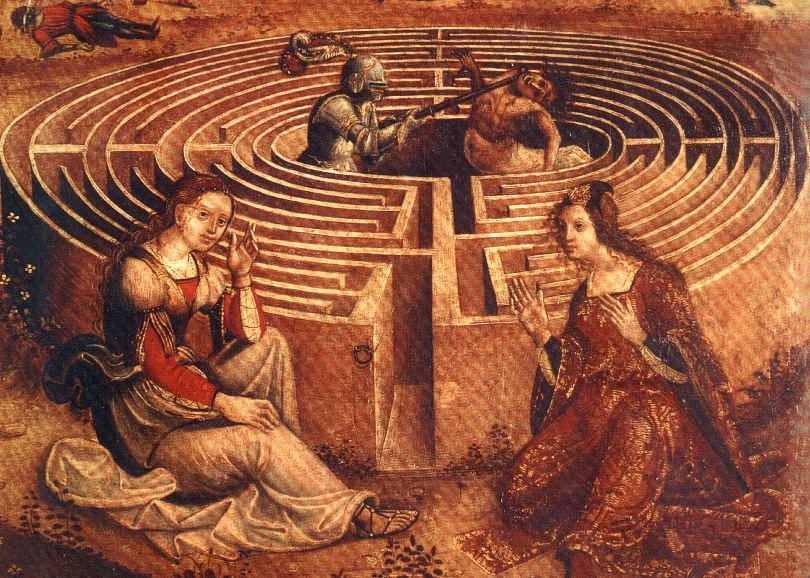
As noted the other day, Ovid's Daedalus has much in common with his Arachne. Both are painstaking artificers who seek to go beyond merely imitating nature. Daedalus' design for the labyrinth of Crete was, Ovid notes, inspired by the Maeander River, near Miletus in ancient Caria:
No differently from the way in which the watery Maeander deludes the sight, flowing backwards and forwards in its changeable course, through the meadows of Phrygia, facing the running waves advancing to meet it, now directing its uncertain waters towards its source, now towards the open sea:
His design for his escape from Crete was based upon nature's model as well:
he applied his thought to new invention and altered the natural order of things. He laid down lines of feathers, beginning with the smallest, following the shorter with longer ones, so that you might think they had grown like that, on a slant. In that way, long ago, the rustic pan-pipes were graduated, with lengthening reeds. Then he fastened them together with thread at the middle, and bees’-wax at the base, and, when he had arranged them, he flexed each one into a gentle curve, so that they imitated real bird’s wings. (Kline)
Like Arachne, Daedalus is entirely absorbed by his art, his techne. He is a problem solver. He solves Pasiphae's problem, then has to contain the problematic issue of that "solution" for Minos:


Sunday, October 16, 2011

Niobe and the poets


This pensive tomb within no dead contains,
This pensive corpse without untomb'd remains;
For, by a strange result of fate's decree,
At once th'unburied dead and tomb you see.

~~~

The gods to stone transform'd me; but, again,
I from Praxiteles new life obtain.

Greek epigrams found in The first twenty-eight Odes of Anacreon: in Greek and in English, John B. Roche, 1827, p. 155

O Niobe, con che occhi dolenti
vedea io te segnata in su la strada,
tra sette e sette tuoi figiuoli spenti!

O Niobe, what tears afflicted me
when, on that path, I saw your effigy
among your slaughtered children, seven and seven!


Mandelbaum translation of Dante, Purgatorio XII.17-19


Dying Niobid, Horti Sallustiani
Frailty, thy name is woman!—
A little month; or ere those shoes were old
With which she followed my poor father’s body
Like Niobe, all tears;—why she, even she,—
O God! a beast that wants discourse of reason,
Would have mourn’d longer,—married with mine uncle,
My father’s brother; but no more like my father
Than I to Hercules:
Hamlet I.2


By children's births, and death, I am become
So dry, that I am now mine own sad tomb.


Thanks to Jutta for this addition:

Oh Rome! my Country! City of the Soul!
The Orphans of the Heart must turn to thee, 695
Lone Mother of dead Empires! and controul
In their shut breasts their petty misery.
What are our woes and sufferance? Come and see
The Cypress, Hear the Owl, and plod your way
O’er steps of broken thrones and temples – Ye! 700
Whose agonies are evils of a day –
A World is at our feet as fragile as our Clay.
The Niobe of Nations! there She stands,
Childless and crownless, in her voiceless woe;
An empty Urn within her withered hands, 705
Whose holy dust was scattered long ago;
The Scipios’ tomb contains no ashes now;
The very Sepulchres lie tenantless
Of their heroic dwellers: dost thou flow,
Old Tiber! through a marble wilderness? 710
Rise, with thy yellow waves, and mantle her distress.
Lord Byron Childe Harold's Pilgrimage Canto IV.78-79

Sunday, August 7, 2011

. . . that faire field of Enna . . .

There's something about the Persephone myth that brings out an intense response from later poets, especially Dante, who imaged his Matilda in the garden of Eden as an eternally inviolate Proserpina, and of course Milton in Paradise Lost IV:

Not that faire field
Of Enna, where Proserpin gathering flours
Her self a fairer Floure by gloomie Dis [ 270 ]
Was gatherd, which cost Ceres all that pain
To seek her through the world;

Shelley took some pains to render Dante's lines from Purgatorio 32:

A solitary woman! and she went _40
Singing and gathering flower after flower,
With which her way was painted and besprent.

'Bright lady, who, if looks had ever power
To bear true witness of the heart within,
Dost bask under the beams of love, come lower _45

Towards this bank. I prithee let me win
This much of thee, to come, that I may hear
Thy song: like Proserpine, in Enna's glen,

Thou seemest to my fancy, singing here
And gathering flowers, as that fair maiden when _50
She lost the Spring, and Ceres her, more dear.


Ovid may have seen Enna and the Lake that he says opened to allow Dis's chariot, bearing Ceres' daughter, access to the Underworld. Enna had been an essentially impregnable fortress from ancient times, due to its unusual situation:
Enna is situated near the center of the island; whence the Roman writer Cicero called it Mediterranea maxime, reporting that it was within a day's journey of the nearest point on all the three coasts. The peculiar situation of Enna is described by several ancient authors, and is indeed one of the most remarkable in Sicily. The ancient city was placed on the level summit of a gigantic hill, so lofty as almost to deserve to be called a mountain, and surrounded on all sides with precipitous cliffs almost wholly inaccessible, except in a very few spots which are easily defended, abundantly supplied with water which gushes from the face of the rocks on all sides, and having a fine plain or table land of about 5 km in circumference on the summit, it forms one of the most remarkable natural fortresses in the world.


Wikipedia goes on to say of Enna:


In historical times it became renowned in Sicily and Italy for the cult of the goddess Demeter (the Roman Ceres), whose grove in the neighborhood was known as the umbilicus Siciliae ("The navel of Sicily"); the origin of the toponym Henna remains obscure.


Ovid's Lake "Pergus," where spring was forever until it wasn't, was near Enna:
The neighborhood of Enna is celebrated in mythological story as the place whence Proserpine was carried off by Pluto.[1] The exact spot assigned by local tradition as the scene of this event was a small lake surrounded by lofty and precipitous hills, about 8 km from Enna, the meadows on the banks of which abounded in flowers, while a cavern or grotto hard by was shown as that from which the infernal king suddenly emerged. This lake is called "Pergus" by Ovid [2] and Claudian,[3]