Showing posts with label purgatorio. Show all posts

Thursday, February 16, 2012

The daedal fates of Icarus

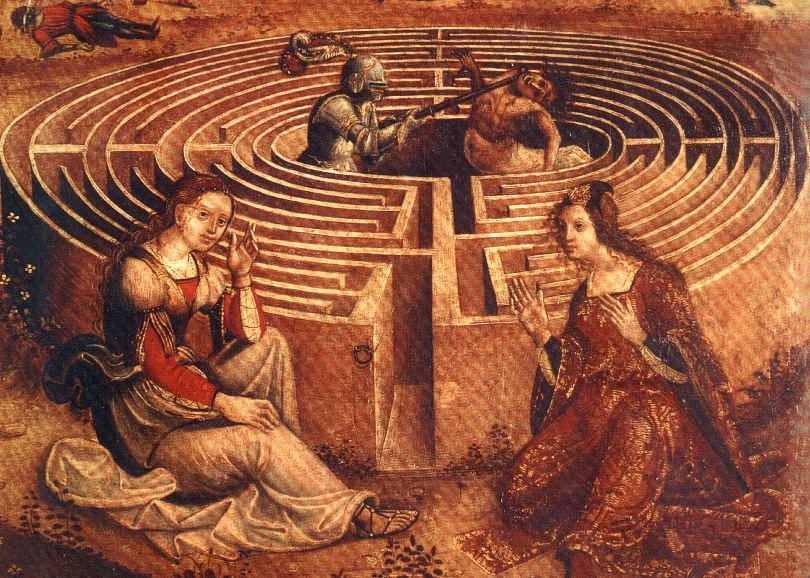
As noted the other day, Ovid's Daedalus has much in common with his Arachne. Both are painstaking artificers who seek to go beyond merely imitating nature. Daedalus' design for the labyrinth of Crete was, Ovid notes, inspired by the Maeander River, near Miletus in ancient Caria:
No differently from the way in which the watery Maeander deludes the sight, flowing backwards and forwards in its changeable course, through the meadows of Phrygia, facing the running waves advancing to meet it, now directing its uncertain waters towards its source, now towards the open sea:
His design for his escape from Crete was based upon nature's model as well:
he applied his thought to new invention and altered the natural order of things. He laid down lines of feathers, beginning with the smallest, following the shorter with longer ones, so that you might think they had grown like that, on a slant. In that way, long ago, the rustic pan-pipes were graduated, with lengthening reeds. Then he fastened them together with thread at the middle, and bees’-wax at the base, and, when he had arranged them, he flexed each one into a gentle curve, so that they imitated real bird’s wings. (Kline)
Like Arachne, Daedalus is entirely absorbed by his art, his techne. He is a problem solver. He solves Pasiphae's problem, then has to contain the problematic issue of that "solution" for Minos:


Sunday, October 16, 2011

Niobe and the poets


This pensive tomb within no dead contains,
This pensive corpse without untomb'd remains;
For, by a strange result of fate's decree,
At once th'unburied dead and tomb you see.

~~~

The gods to stone transform'd me; but, again,
I from Praxiteles new life obtain.

Greek epigrams found in The first twenty-eight Odes of Anacreon: in Greek and in English, John B. Roche, 1827, p. 155

O Niobe, con che occhi dolenti
vedea io te segnata in su la strada,
tra sette e sette tuoi figiuoli spenti!

O Niobe, what tears afflicted me
when, on that path, I saw your effigy
among your slaughtered children, seven and seven!


Mandelbaum translation of Dante, Purgatorio XII.17-19


Dying Niobid, Horti Sallustiani
Frailty, thy name is woman!—
A little month; or ere those shoes were old
With which she followed my poor father’s body
Like Niobe, all tears;—why she, even she,—
O God! a beast that wants discourse of reason,
Would have mourn’d longer,—married with mine uncle,
My father’s brother; but no more like my father
Than I to Hercules:
Hamlet I.2


By children's births, and death, I am become
So dry, that I am now mine own sad tomb.


Thanks to Jutta for this addition:

Oh Rome! my Country! City of the Soul!
The Orphans of the Heart must turn to thee, 695
Lone Mother of dead Empires! and controul
In their shut breasts their petty misery.
What are our woes and sufferance? Come and see
The Cypress, Hear the Owl, and plod your way
O’er steps of broken thrones and temples – Ye! 700
Whose agonies are evils of a day –
A World is at our feet as fragile as our Clay.
The Niobe of Nations! there She stands,
Childless and crownless, in her voiceless woe;
An empty Urn within her withered hands, 705
Whose holy dust was scattered long ago;
The Scipios’ tomb contains no ashes now;
The very Sepulchres lie tenantless
Of their heroic dwellers: dost thou flow,
Old Tiber! through a marble wilderness? 710
Rise, with thy yellow waves, and mantle her distress.
Lord Byron Childe Harold's Pilgrimage Canto IV.78-79