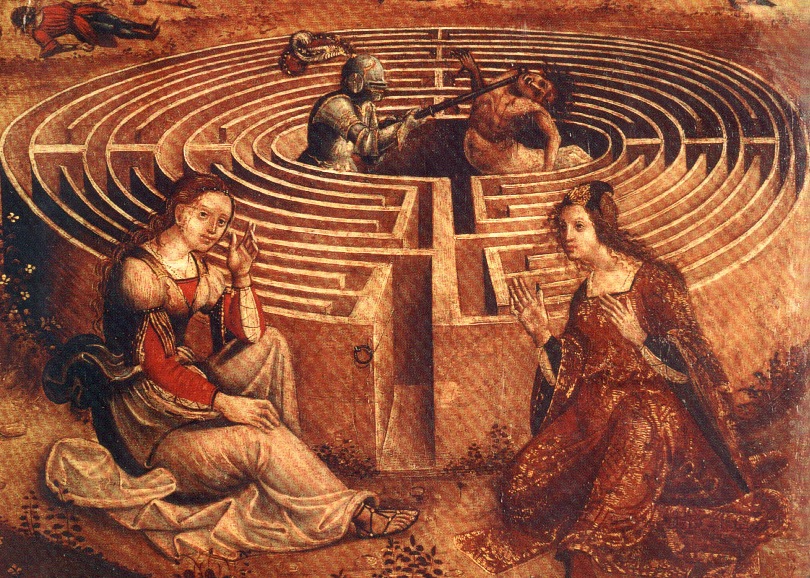
Saturday, February 25, 2012

Questions spurred by a hunt

Some of the questions coming up for me with the story of Meleager, Atalanta, Althea and the Calydonian Boar: What are yours?

1. Prof. William S. Anderson notes that the boar hunting scene is closer to farce than to heroic spectacle, with vignettes of great heroes falling on their faces, scrambling to do pole vaults, and hurling errant projectiles, not without tragic consequences. This might remind us of the bloody massacre at the wedding banquet of Perseus and Andromeda, and goes to the recurrent observation that Ovid seems to tote epic paraphernalia out of the closet only to do strange, poetically subversive things with it. Couple this with the fact that many of the characters whose conflicts and emotions are explored in detail through these tales are women: Arachne, Niobe, Medea, Scylla and Althea, for example. Is Ovid, writing in a cosmopolitan urban setting, consciously broadening the scope of this large-scale poem to attract new segments of readers?

2. Why does Meleager, a young, strong and almost immortal man, choose to invite heroes from all over Greece to participate in the hunt?

Althea with the brand of Meleager
3. Why does the hunting party object to the presence of Atalanta? Why do they object to Meleager's awarding her the spoils of the hunt? Why does he so honor her?

4. Why does Meleager kill both of his mother's brothers? What do they do that provokes his wrath?

5. How is this tale of a powerful, seemingly random natural aggressor wreaking havoc complicated by framing it with the divine elements of the Fates (Parcae), Diana, and the Furies (Poenae), and the fateful acts of his parents, Oeneus and Althea?

6. What to make of the parallel between the "smoldering" feelings Meleager feels for Atalanta and the consuming flames of Althea's act? Why is Althea moved to destroy her son? What is at the core of her almost epic inner conflict?

7. The staging of the hunt, notable for heroes throwing erring projectiles, can certainly remind us of Cephalus and his unerring spear (iaculum). What other relationships might suggest themselves between the tale of Meleager and other preceding tales -- Minos and Daedalus, Minotaur and Pasiphae, Scylla and Nisus?

8. How to take the epic magnitude of the expression of grief that overwhelms Calydon after the death of Meleager and his parents? Especially the sisters:

Not though the god had given me a hundred mouths speaking with tongues, the necessary genius, and all Helicon as my domain, could I describe the sad fate of his poor sisters. 8.533-35

[update] 9. Who is hunting whom?

Thursday, February 23, 2012

Features of Meleager and Atalanta


Among the curious features of Ovid's story of Meleager, Atalanta, and the Calydonian Boar Hunt:

The large assembly of mythological heroes from all around Greece -- a gathering comparable only to the group that joined Jason in his quest, and to the armies of Agamemnon in the Iliad.

The manner in which Ovid introduces the heroes is interesting. He names 36 men in rapid-fire succession, and many of them are paired as brothers, twins, or close friends (Theseus and Pirithous, e.g.). Then he comes to Atalanta. Only she receives a description:

Atalanta


And Atalanta, the warrior girl of Tegea, the glory of Arcadia’s woods, with a polished brooch clasping the neck of her garment, and her hair simply done, caught in a single knot. An ivory quiver, holding her arrows, that rattled as she moved, hung from her left shoulder, and her left hand held the bow. So she was dressed: as for her face, you might truly say, the virgin was there, in a boy, and a boy, in the girl.


This gesture of singling out one from a crowd will be repeated within the story itself. Here the one singled out is distinguishable in part for the ambiguity of her features -- she's almost a single set of twins, boy and girl in one, and her childhood -- saved and reared by bears and hunters! She seems a being on the border between the human and a thing of nature.

Wikipedia offers some background on Meleager and Atalanta. Ovid sets the scene in "rich Achaea" in the north of the Peloponnese peninsula.

Prior to the Metamorphoses, Meleager appears in Apollodorus, and in a tale told by Phoenix in the Iliad 9.529 ff -- there he's cited as a parallel to and gloss upon Achilles, sitting out the siege of his own city because of anger towards his mother. This is discussed here as well.

A common themed sarcophagus in Roman times was the Meleager Sarcophagus.


More about Meleager.


Tuesday, February 21, 2012

Ovid's 2055th Birthday to be Celebrated in Sarasota


MAR. 20, 2012 | 6 pm | New College Florida/New College Oxford Exchange
David Raeburn, New College University of Oxford


Bookstore 1, 1359 Main Street
Free and open to the public

This year's participant in the New College Florida/New College Oxford exchange is David Raeburn, a scholar of Greek drama and Greek and Latin poetry who teaches at New College University of Oxford. His work includes translations of Ovid's Metamorphoses and Sophocles' Electra and other plays for Penguin Classics. Raeburn will be reading selections from his translation of Ovid's Metamorphoses at Bookstore 1, 1359 Main Street, on March 20, which happens to be the 2,055th birthday of Ovid.

Sunday, February 19, 2012

Library's metamorphosis


An article in today's paper addresses plans for the expansion of the Gulf Gate Library. The county is gathering input from users:
An open house meeting is scheduled for Thursday [Feb. 23] from 4:30 p.m. to 7 p.m. at St. Andrew United Church of Christ, 6908 Beneva Road, Sarasota. Kalajian and other members of the library staff will be there, along with representatives from the project's architects, Harvard Jolly Architecture. Library patrons are encouraged to stop by and ask questions, share opinions and learn more about the project. 

Also:
Construction is planned to begin in early 2013. Whether the current building will stay open during the construction period or the library will operate out of temporary quarters is still to be determined. More...

Friday, February 17, 2012

Ovid, Aphrodite and Eros in Boston


A show at the Boston Museum of Fine Arts features images of Aphrodite from Italy and its own collection, including one of our friend Salmacis from Metamorphoses 4 :

There dwelt a Nymph, not up for hunting or archery:
unfit for footraces. She the only Naiad not in Diana’s band.
Often her sisters would say: “Pick up a javelin, or
bristling quiver, and interrupt your leisure for the chase!”
But she would not pick up a javelin or arrows,
nor trade leisure for the chase.
Instead she would bathe her beautiful limbs and tend to her hair,
with her waters as a mirror.

An article from Apollo magazine about the show is online here, and one from the Daily Beast is here. One image is of Eros wearing Heracles' Nemean Lion skin.

An article about the sleeping Hermaphrodite is here. More slides from the BMFA show, which closes shortly, are on this page under "exhibition highlights."

And a story about theft in the museum in Olympia.


Sleeping Borghese Hermaphroditus


Thursday, February 16, 2012

The daedal fates of Icarus

As noted the other day, Ovid's Daedalus has much in common with his Arachne. Both are painstaking artificers who seek to go beyond merely imitating nature. Daedalus' design for the labyrinth of Crete was, Ovid notes, inspired by the Maeander River, near Miletus in ancient Caria:
No differently from the way in which the watery Maeander deludes the sight, flowing backwards and forwards in its changeable course, through the meadows of Phrygia, facing the running waves advancing to meet it, now directing its uncertain waters towards its source, now towards the open sea:
His design for his escape from Crete was based upon nature's model as well:
he applied his thought to new invention and altered the natural order of things. He laid down lines of feathers, beginning with the smallest, following the shorter with longer ones, so that you might think they had grown like that, on a slant. In that way, long ago, the rustic pan-pipes were graduated, with lengthening reeds. Then he fastened them together with thread at the middle, and bees’-wax at the base, and, when he had arranged them, he flexed each one into a gentle curve, so that they imitated real bird’s wings. (Kline)
Like Arachne, Daedalus is entirely absorbed by his art, his techne. He is a problem solver. He solves Pasiphae's problem, then has to contain the problematic issue of that "solution" for Minos:


Wednesday, February 15, 2012

The ant and the shell: Daedalus and Minos in Sicily


After the curiously juxtaposed tales of Daedalus and Icarus and Daedalus and Perdix/Talus, Ovid gives very short shrift (8.260-62) to two tales that bring some closure to the careers of Daedalus and Minos. (We really should give further thought to the fact that Ovid differs from most storytellers in being exceedingly nonchalant about giving his stories what Frank Kermode would call The Sense of an Ending: Studies in the Theory of Fiction (with a New Epilogue)).

Here's the story: This version comes from: Daedalus and Minos at the court of King Cocalus in Sicily:
After the loss of his son Icarus, Daedalus managed to reach Camicus or Cumae in Sicily, the kingdom of Cocalus, on his own. But King Minos of Crete did not stop hunting him. He knew that the wise Daedalus would find a way to cover his tracks, so he had to think up a way to flush him out of his hiding-place. 
Nautilus fossil: Golden Ratio
Minos sent word to all the kings of the known world, that whoever of their subjects was able to solve a puzzle would be richly rewarded. Minos believed that only Daedalus could solve the difficult puzzle: to string a thread through a conch shell.

King Cocalus, who had given Daedalus shelter in his court, had of course realised the abilities of the legendary craftsman and asked him to solve the puzzle. He hoped that if Daedalus solved it, his kingdom would gain prestige and perhaps even Minos’ favour. 
Daedalus pierced a hole in the tip of the conch shell, smeared it with honey, and tied the thread around an ant, which, attracted by the honey, wound its way through the spirals of the empty shell taking the thread with it. 
Cocalus joyfully announced to Minos that the puzzle had been solved, never suspecting that he was thus betraying Daedalus, the most-wanted fugitive in Minoan Crete.

Minos immediately understood that Daedalus was in Sicily, and sailed there in person to get him back from Cocalus. Cocalus did not want to oppose the powerful King of Crete, but neither did he want to lose Daedalus’ services. So, although he promised to deliver the craftsman to Minos, he decided to murder the latter. The great King of Crete met an inglorious end in a boiling bath. The murder was planned to look like an accident, ensuring that the crafty Cocalus would go unpunished. 
All of the above may be no more than a myth, but it conceals the historical truth that the Minoan Cretans founded colonies in Sicily, such as Minoa in Acragas (Agrigentum), Hyria in Messapia and Engyos in the interior of the island. (Links added. Another version of the story can be found in Apollodorus, E.1.13-15.)

Tuesday, February 14, 2012

Sneaky gods and Cretans

How shall we sing of him – as lord of Dicte1 or of Lycaeum?2 
My soul is all in doubt, since debated is his birth. 
O Zeus, some say that thou wert born on the hills of Ida3; 
others, O Zeus, say in Arcadia; did these or those, O Father lie? 
“Cretans are ever liars.”4 
Yea, a tomb,5 O Lord, for thee the Cretans builded; 
but thou didst not die, for thou art for ever. 
Callimachus, Hymn to Zeus


Rembrandt: Zeus & Europa (detail)

The Cretan world of Book 8 originated in the "rape" of Europa, depicted at the end of Book 2 (and by Arachne in Book 6.103). It was, as Ovid tells it, more of a beguilement, a ruse of the king of the gods, capturing the maiden's interest, and seducing her to play with the gentle-seeming beast. 


Rhea gives "Zeus" to Cronos
Zeus absconded with the girl to the sacred isle of his cradle, where another ruse, long before, had protected Baby Zeus from the devouring determination of his father, Cronos.

From its beginning, Crete is associated with lies, artful dodges, and false appearances (the stone Rhea presents to Cronos). It also has topographical features associated with Zeus, including a plain where the baby's navel fell off, according to a hymn by Callimachus. 

The Cretans, also called Curetes, danced and beat their armor so that Cronos wouldn't hear his latest child cry, the poet adds. But as he says in the verses above, little is certain about what Cretans say.

It's suggestive is that a generation of gods avoided annihilation by virtue of ambiguity and deception.

Here's a brief outline of Book 8, with links to the individual tales on Theoi.com:

BOOK 8
1. Minos & Scylla
2. Daedalus & Icarus
3. Calydonian Boar Hunt
4. Althaea & Meleager
5. Perimela & Achelous
6. Baucis & Philemon
7. Erysichthon & Mestra

Sunday, February 12, 2012

A bit about labyrinths


Book 8 is the central book of Metamorphoses, and perhaps not entirely by chance contains Ovid's memorable description of the labyrinth of Crete. We'll look at that description in more detail in a later post, but for now, it's worth noting that in order for something to be a labyrinth, it must have a center. Mazes can offer a confusing multiplicity of paths, but labyrinths should have one route, however intricate, leading from outside to center:


Cretan Labyrinth

Websters Online has quite a lavish page about the word "labyrinth," including this brief definition:
The term labyrinth is often used interchangeably with maze, but modern scholars of the subject use a stricter definition. For them, a maze is a tour puzzle in the form of a complex branching passage with choices of path and direction; while a single-path (unicursal) labyrinth has only a single Eulerian path to the center.
As my son Sawyer noted, when you actually trace the route of a labyrinth like the one above, you in fact traverse every inch of it.

For more about the distinction between mazes and labyrinths, and about the history and types of labyrinths, see Labyrinthos.

Another brief overview that sorts the three basic designs into Cretan, Roman, and Medieval, can be found here.

The labyrinth of Chartres Cathedral is one of the glories of Medieval design:

Chartres

A very detailed and generously illustrated history of labyrinths and mazes from Egypt to recent times by Roberta Barresi can be found on multiple pages beginning here. As Barresi finds, the labyrinth took on different kinds of meanings and uses in different cultural epochs. More on that here as well.


Italian image of Roman Labyrinth

Friday, February 10, 2012

Some motifs in Metamorphosis 8

If Book 7 of the Metamorphoses addresses foedera -- faith, trust, and the ultimate investments individuals and nations place in bonds with others -- Book 8 seems preoccupied with a set of perspectives on vulnerability, strategies of defense, and the infamy of treachery, the betrayal of foedera.

One word for the moral repugnance of traitorous acts is the adjective foedus:

foedus m (feminine foeda, neuter foedum); first/second declension (physically) filthy, foul, disgusting, loathsome, ugly, unseemly, detestable, abominable, horrible (mentally) disgraceful, vile, obscene, base, dishonorable, shameful, infamous, foul

In the tale of Scylla and Nisus, not all the arma of Crete, but rather one young girl's amor brought down her father's city. Look for parallels as the book moves on to the tales of Minos, Daedalus, and Meleager. What do the various unexpected deaths have to tell us about vulnerability?

Aetolia and Achelous
The book is also rich in at least two other motifs: rivers and forgetting. The second half is largely taken up by a conversation with Achelous, the largest river of Greece, the one that defines Aetolia and Acarnania.

We'll be hearing about the nymphs who forgot him:
At the mouth of the Achelous River lie the Echinades Islands. [They] were once five nymphs. Unfortunately for them, they forgot to honor Achelous in their festivities, and the god was so angry about this slight that he turned them into the islands.

Achelous